
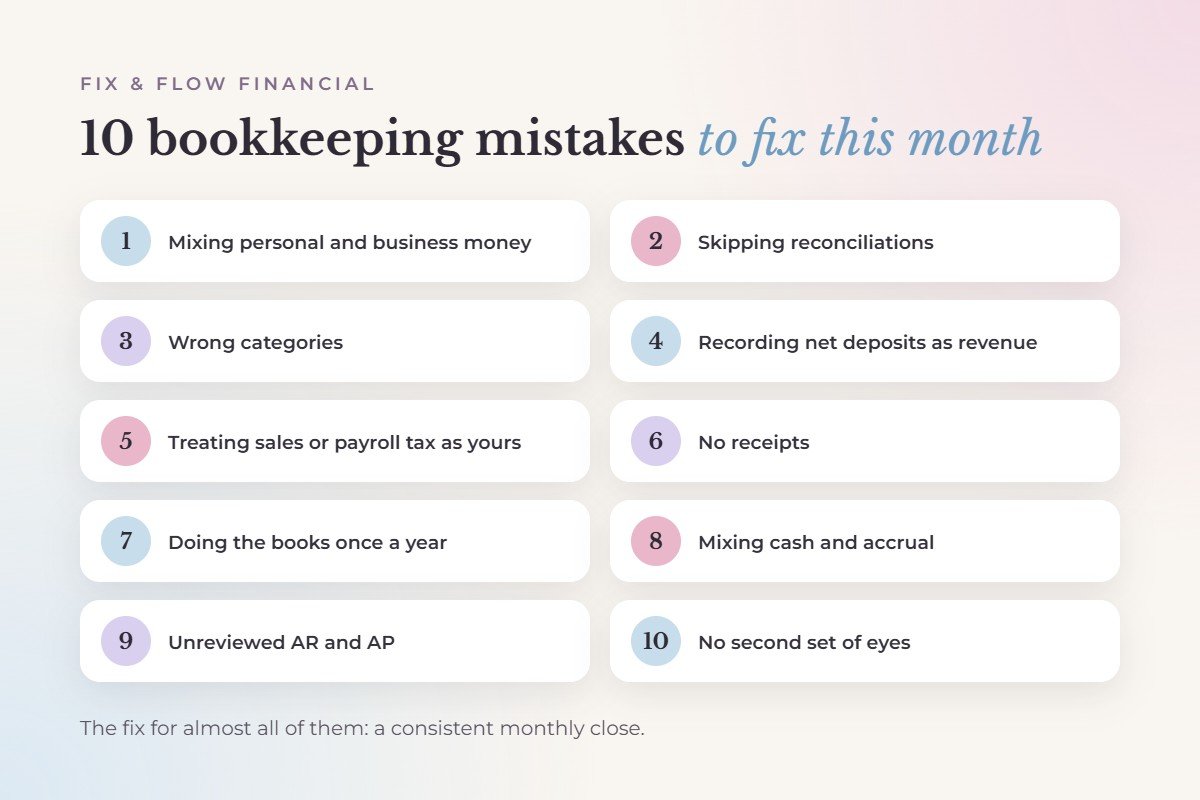
Most bookkeeping problems don't start as big problems. They start as small habits that compound month after month until tax season, a loan application, or a cash crunch exposes them. These are the ten mistakes we see most often, and how to avoid each one.

1. Mixing personal and business money
Commingling is the most common mistake, especially for new businesses. It makes your books hard to verify, distorts your profit, costs you deductions, and for LLC and corporation owners it can put personal assets at risk. Use a dedicated business bank account and card, and record any money you move in or out as an owner draw or contribution, never as revenue or an expense.
2. Skipping reconciliations
The IRS advises reconciling your checking account every month. Skip it and small errors snowball, old items linger, and duplicates or fraud go unnoticed. Aim for a $0 unexplained difference on every account, every month.
3. Putting transactions in the wrong category
Recording loan payments as expenses, expensing equipment purchases, booking owner draws as costs, or recording payroll at the net amount instead of gross wages. Each one distorts your margins, your taxes, and every ratio a lender looks at.
4. Recording net deposits as revenue
Payment processors, marketplaces, and POS systems pay you after taking out fees, refunds, and sometimes tax. If you only record the deposit, your revenue, your fees, and your margin are all wrong at once. Record the gross sale and the fees separately.
5. Treating sales tax or payroll tax as your money
Sales tax you collect and taxes withheld from employees belong to the government. You're holding them until they're due. Keep them in liability accounts, not revenue, and don't count them as cash you can spend.
6. Not keeping receipts
The IRS requires you to back up your deductions. Lost receipts mean lost deductions and items that can be disallowed in an examination. Snap a photo or forward digital receipts the day you get them.
7. Doing the books once a year
"Shoebox bookkeeping" turns your books from a management tool into a history project. By the time you see a problem, it's months old. A monthly close keeps the numbers useful while you can still act on them.
8. Confusing cash received with revenue earned
Mixing cash and accrual logic in the same set of books makes your reports unreliable. Pick a method, apply it consistently, and make sure every report states which method it uses.
9. Letting receivables and payables go unreviewed
Old invoices never get chased, vendor bills get paid twice, and credits never get applied. Review your AR and AP aging reports every month.
10. No second set of eyes
When the person entering transactions is the only person who ever looks at them, mistakes and fraud can go undetected. Even a small business can separate duties: have someone other than the person moving money review the reconciliations.
The fix: a consistent monthly close
Almost every mistake on this list is caught by the same habit: closing your books every month, on a schedule, with every account reconciled and reviewed. Good books are complete, reconciled, consistently categorized, reviewed, on time, and kept separate from personal finances.
If your books are behind or you're not sure they're right, our FIX service gets them caught up and cleaned up, and our monthly FLOW service keeps them that way. Book a free consultation to see where your books stand.
Sources: IRS Publication 583, Starting a Business and Keeping Records; common-mistake lists compiled from CPA and bookkeeping firm guidance (Protea, Decimal, MBS CPA, Accountix). This article is general education, not tax or legal advice.