
Your profit and loss statement says you had a good month. Your bank account says otherwise. If that sounds familiar, nothing is necessarily wrong with your books. Profit and cash are two different things, and knowing the difference is one of the most useful financial skills a business owner can have.

Why profit and cash don't match
Profit is recorded when you earn it: when you deliver the work or make the sale. Cash moves on a different schedule, driven by when customers pay you, when you buy inventory, and when you pay your bills. That timing gap is why a business can be profitable on paper and still be short on cash.
Three things usually explain the gap:
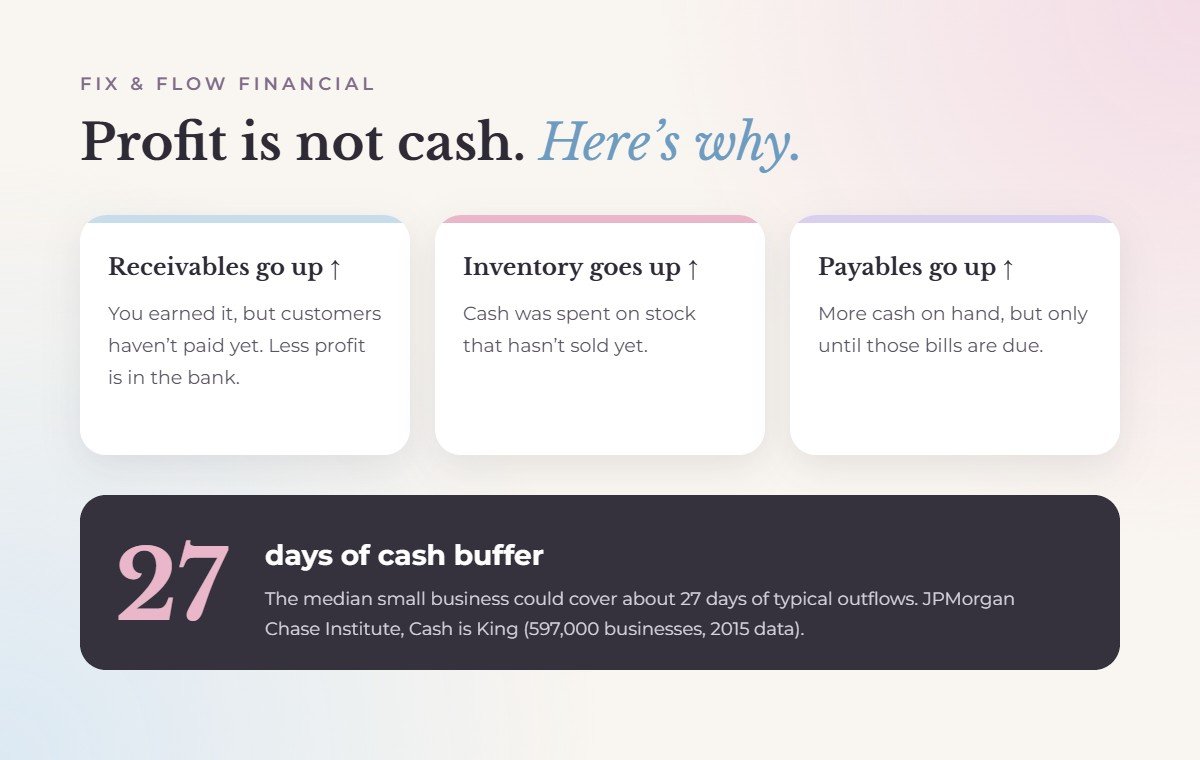
Accounts receivable goes up. You invoiced the work, so it counts as profit, but the customer hasn't paid yet. Less of your profit is actually in the bank.
Inventory goes up. You spent cash on stock that hasn't sold yet.
Accounts payable goes up. You have more cash on hand, but only temporarily, because those bills are still due.
The cushion is thinner than most owners think
JPMorgan Chase Institute's Cash is King study of 597,000 small businesses found that the median small business holds just 27 cash buffer days, meaning it could cover about 27 days of typical outflows if money stopped coming in. A quarter of small businesses held 13 days or fewer, and restaurants held the fewest, at 16 days. (The study covers 2015 data, so treat it as a long-standing benchmark rather than a 2026 reading.)
More recent surveys point the same way. In the Federal Reserve Banks' 2025 Report on Employer Firms, 51% of firms cited uneven cash flows as a financial challenge and 56% cited paying operating expenses. And Intuit QuickBooks' 2025 Late Payments Report found that 56% of small businesses were owed money on unpaid invoices, averaging $17,500 outstanding per business.
How to read your own numbers
You don't need to become an accountant to stay ahead of cash. Each month, look at three things together:
Profit and loss: did you make money this month?
Accounts receivable aging: how much is owed to you, and how old is it? Invoices drifting past 30, 60, or 90 days are cash you've earned but can't use.
Cash flow statement: where did the cash actually go: operations, equipment, loan payments, or owner draws?
Read together, these explain a profitable but empty bank account, and they tell you when it's safe to hire, buy equipment, or take a draw.
Simple habits that protect your cash
Invoice promptly and follow up on anything past 30 days.
Keep sales tax and payroll taxes out of your "available" cash. That money was never yours to spend.
Reconcile your bank and credit card accounts every month so the cash figure you see is real.
Build a simple cash flow projection for the next few months, and keep confirmed amounts separate from estimates.
How Fix & Flow helps
Every month, our clients get a Financial Snapshot: their statements plus a plain-language explanation of what changed, what's coming in and going out, and the two or three things to act on next. If your profit and your bank balance never seem to agree, book a free consultation and we'll walk through your numbers together.
Sources: JPMorgan Chase Institute, Cash is King (597,000 businesses, 2015 data); Federal Reserve Banks, 2025 Report on Employer Firms; Intuit QuickBooks, 2025 U.S. Small Business Late Payments Report (2,487 businesses, January 2025). This article is general education, not tax or legal advice.